For many small business owners, intellectual property is one of the most overlooked assets on the balance sheet. Entrepreneurs spend years developing products, software, processes, branding, and customer experiences, yet many never take the legal steps necessary to protect what they built. A patent can create a competitive moat, increase company valuation, attract investors, and prevent competitors from copying a core innovation.
At the same time, patents are not always necessary — and in some cases, pursuing one can waste valuable capital. The key is understanding what patents actually protect, when they make strategic sense, and how small businesses can use them intelligently without overextending themselves financially.
What Is a Patent?
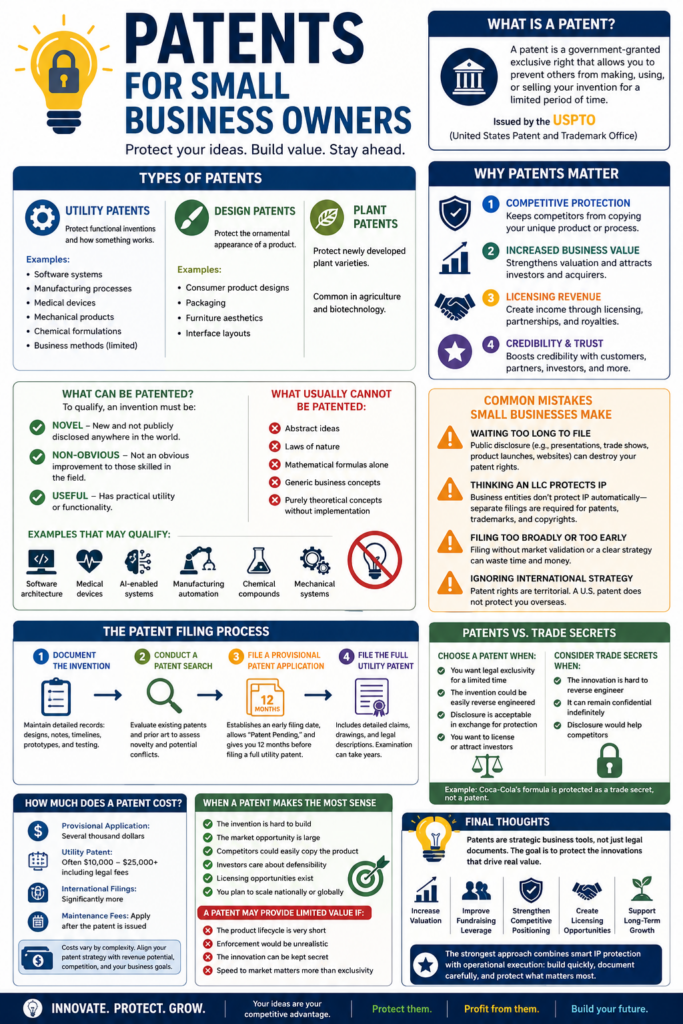
A patent is a government-granted exclusive right that allows an inventor to prevent others from making, using, or selling an invention for a limited period of time. In the United States, patents are issued by the United States Patent and Trademark Office (USPTO).
Patents generally fall into three categories:
Utility Patents
These protect functional inventions such as:
- Software systems
- Manufacturing processes
- Medical devices
- Mechanical products
- Chemical formulations
- Business methods in limited circumstances
Utility patents are the most common type for startups and operating businesses.
Design Patents
These protect the ornamental appearance of a product rather than its functionality. Examples include:
- Consumer product designs
- Packaging
- Furniture aesthetics
- Interface layouts
Plant Patents
These apply to newly developed plant varieties and are more relevant in agriculture and biotechnology.
Why Patents Matter for Small Businesses
1. Competitive Protection
A patent can prevent competitors from copying a unique product or process. This is especially important for companies that:
- Invest heavily in R&D
- Operate in niche markets
- Depend on technical differentiation
- Have limited pricing power
Without protection, larger competitors may replicate an innovation and outspend the original creator in marketing and distribution.
2. Increased Business Valuation
Investors and acquirers often view patents as strategic assets because they can:
- Create barriers to entry
- Support premium pricing
- Enhance licensing opportunities
- Reduce competitive threats
For startups seeking venture capital, patents can strengthen due diligence discussions and demonstrate defensibility.
3. Licensing Revenue
Some companies monetize patents directly through:
- Licensing agreements
- Strategic partnerships
- Royalty structures
- Joint ventures
A small business may not even need to manufacture the product itself if the patent portfolio has licensing value.
4. Credibility and Market Positioning
Holding patents can enhance credibility with:
- Customers
- Strategic partners
- Universities
- Government agencies
- Investors
In highly technical industries such as biotech, medical devices, software infrastructure, or advanced manufacturing, patents may serve as proof of innovation capacity.
What Can Be Patented?
To qualify for patent protection, an invention generally must be:
Novel
The invention must be new and not already publicly disclosed anywhere in the world.
Non-Obvious
The invention cannot be an obvious improvement that a skilled professional in the industry could easily infer.
Useful
The invention must have practical utility or functionality.
Examples that may qualify:
- Proprietary software architecture
- Medical treatment devices
- AI-enabled workflow systems
- Manufacturing automation methods
- Unique hardware configurations
- Chemical compounds
- Mechanical systems
Examples that usually do not qualify:
- Abstract ideas
- Laws of nature
- Mathematical formulas alone
- Generic business concepts
- Purely theoretical concepts without implementation
Common Mistakes Small Businesses Make
Waiting Too Long to File
One of the most damaging mistakes is publicly disclosing an invention before filing. This can happen through:
- Investor presentations
- Trade shows
- Product launches
- YouTube demos
- Website screenshots
- Academic publications
In many countries, public disclosure before filing can permanently eliminate patent rights.
Assuming an LLC Automatically Protects IP
Forming an LLC or corporation does not automatically protect intellectual property. Separate legal filings are required for:
- Patents
- Trademarks
- Copyrights
A business entity protects liability exposure — not innovation ownership by itself.
Filing Too Broadly or Too Early
Patent filings can become expensive quickly. Small businesses should avoid filing broad applications without:
- Market validation
- Revenue traction
- A commercialization strategy
Sometimes trade secret protection may be more practical than a patent.
Ignoring International Strategy
Patent rights are territorial. A U.S. patent does not automatically protect an invention overseas. Businesses manufacturing internationally should consider whether foreign filings are strategically necessary.
The Patent Filing Process
Step 1: Document the Invention
Maintain:
- Design records
- Engineering notes
- Development timelines
- Prototype documentation
Good documentation can become important later during prosecution or litigation.
Step 2: Conduct a Patent Search
A patent attorney or search professional can evaluate:
- Existing patents
- Similar technologies
- Potential conflicts
- Patentability likelihood
This reduces the risk of spending money on an invention that lacks novelty.
Step 3: File a Provisional Patent Application
Many startups begin with a provisional patent application. This:
- Establishes an early filing date
- Allows use of “Patent Pending”
- Provides 12 months before filing a full utility patent
A provisional filing is often cheaper and useful during early fundraising or product testing.
Step 4: File the Full Utility Patent
The formal non-provisional application includes:
- Detailed claims
- Technical drawings
- Legal descriptions
- Prior art analysis
The examination process can take years depending on the technology area.
Patents vs. Trade Secrets
Not every innovation should be patented.
Some businesses choose trade secret protection instead, especially when:
- The process is difficult to reverse engineer
- The innovation could remain confidential indefinitely
- Disclosure through a patent would help competitors
Examples:
- Manufacturing formulas
- Internal algorithms
- Proprietary workflows
- Customer scoring systems
The classic example is The Coca-Cola Company protecting its formula as a trade secret rather than through a patent.
How Much Does a Patent Cost?
Costs vary widely depending on complexity.
Typical ranges:
- Provisional application: several thousand dollars
- Utility patent: often $10,000–$25,000+ including legal fees
- International filings: significantly more
Maintenance fees also apply after issuance.
For small businesses, patent strategy should be tied to:
- Revenue potential
- Investor expectations
- Competitive landscape
- Exit strategy
When a Patent Makes the Most Sense
Patents tend to provide the most value when:
- The invention is hard to build
- The market opportunity is large
- Competitors could easily copy the product
- Investors care about defensibility
- Licensing opportunities exist
- The business plans to scale nationally or globally
In contrast, a patent may provide limited value if:
- The product lifecycle is very short
- Enforcement would be unrealistic
- The innovation can be kept secret
- Speed to market matters more than exclusivity
Final Thoughts
Patents are not merely legal documents — they are strategic business tools. For small business owners, the goal should not be to patent everything, but to protect the innovations that truly drive enterprise value.
A thoughtful intellectual property strategy can:
- Increase valuation
- Improve fundraising leverage
- Strengthen competitive positioning
- Create licensing opportunities
- Support long-term growth
The strongest approach usually combines legal protection with operational execution: building quickly, documenting innovation carefully, and protecting the assets that matter most.